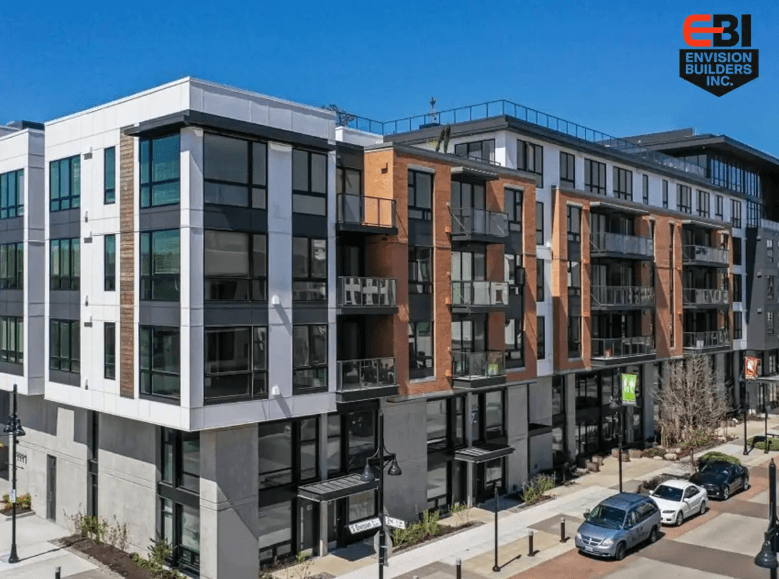
Whether you’re developing multifamily housing, renovating a community, or building your dream home — the contractor you hire shapes everything that follows.
Every major construction project begins the same way — with a vision. Maybe it’s a six-unit townhome development in Renton, a commercial tenant improvement in Bellevue, an HOA exterior overhaul in Kirkland, or a custom home in the Puget Sound foothills. Whatever the project, the single most consequential decision you’ll make isn’t the floor plan, the finishes, or the financing. It’s who you hire to build it.
The general contractor you choose determines your budget’s integrity, your timeline’s reliability, and the long-term performance of the structure you’ll own for decades. In a competitive, fast-moving construction market like Western Washington, that choice matters more than ever.
So what separates a great general contractor from a costly mistake? Here’s what property owners, developers, HOA boards, and homeowners across the Seattle region should know before signing a contract.
1. Preconstruction Is Where Projects Are Won or Lost
Most clients focus on the construction phase — the visible work happening on site. But experienced builders know that the real difference between a project that stays on budget and one that spirals out of control is what happens before a single nail is driven.
Preconstruction planning encompasses site analysis, permit strategy, subcontractor vetting, scheduling, value engineering, and detailed cost estimating. A contractor who invests serious time in this phase will surface budget risks early, identify design conflicts before they become change orders, and create a realistic schedule that accounts for lead times, inspection cycles, and weather windows.
“A strong preconstruction process doesn’t add cost — it prevents it.”
When evaluating a contractor, ask specifically: What does your preconstruction process look like? How do you develop your initial budget, and how do you handle scope gaps? If you get a vague answer, that’s a red flag.
2. Communication Isn’t a Soft Skill — It’s a Project Management Tool
Construction projects involve dozens of moving parts: architects, engineers, subcontractors, inspectors, material suppliers, and clients. When communication breaks down between any of these parties, delays and cost overruns follow almost immediately.
The best contractors are obsessive about transparency. They provide regular written updates, document decisions, flag issues the moment they arise, and give clients a real-time picture of where the project stands against schedule and budget. You should never be surprised by what’s happening on your build.
This is especially critical for HOA and multifamily projects, where the impact of construction extends to residents who are living in or around the work zone. A contractor who can’t manage stakeholder communication in those environments isn’t equipped for the job.
3. Local Knowledge Is a Competitive Advantage
Washington State has its own building codes, seismic requirements, energy standards, and permit processes — and every municipality adds another layer. A contractor who has deep roots in King, Pierce, Snohomish, Thurston, and Kitsap counties understands the local AHJ (Authority Having Jurisdiction) relationships, inspection timelines, and code interpretations that can make or break a schedule.
This local expertise also extends to subcontractor networks. Established contractors in the Puget Sound region have vetted relationships with electricians, plumbers, framers, and specialty trades who understand the regional demands of Pacific Northwest construction — moisture management, soil conditions, seismic detailing, and more.
When a project hits a curveball — and they always do — a contractor with strong local relationships can respond quickly. An out-of-market firm often cannot.
4. The Managing General Contractor Model: A Smarter Way to Build
One approach gaining traction among sophisticated developers and property owners is the Managing General Contractor (MGC) model. Rather than simply subcontracting all work and marking it up, an MGC takes on a broader leadership role — acting almost as an owner’s representative embedded within the construction process.
In this structure, the contractor provides detailed cost transparency, assists with subcontractor selection, and actively manages the project’s financial and operational performance on the owner’s behalf. The result is better alignment of incentives, fewer surprises, and stronger outcomes for the owner.
This model works especially well for complex multifamily and commercial projects where owners want visibility into cost structures, subcontractor performance, and budget risk — without hiring a full-time internal construction team.
“The best contractors don’t just execute your vision — they protect your investment.”
5. Questions Every Client Should Ask Before Hiring
Before you sign a construction contract, make sure you can answer these questions about the firm you’re considering:
- Do they have verifiable experience with your specific project type — multifamily, commercial, HOA, or custom residential?
- Can they provide references from recent, comparable projects in the Puget Sound region?
- How do they handle change orders, and what’s their track record for delivering on budget?
- What does their subcontractor vetting process look like, and do they carry appropriate licensing and insurance?
- How do they approach preconstruction, and will they provide detailed cost breakdowns before construction begins?
- What communication cadence and reporting tools will they use to keep you informed throughout the project?
The answers to these questions will tell you far more than a polished sales presentation ever will.
6. Long-Term Value Over Lowest Bid
In construction, the lowest bid is almost never the best deal. A contractor who wins work by cutting their number often does so by cutting scope, underpaying subcontractors, using inferior materials, or simply underestimating what the project actually requires. The resulting change orders, delays, and quality deficiencies frequently cost more than the initial savings.
Sophisticated clients — developers who build repeatedly, HOA boards overseeing multimillion-dollar capital programs, commercial property owners — know this intuitively. They evaluate proposals based on the clarity of scope, the depth of preconstruction work, the quality of the team, and the contractor’s track record. Price matters, but it’s one input among many.
A well-built structure will outperform for decades. A poorly built one creates problems — and costs — long after the contractor has moved on.
See also: Why Darkero Health Technology Is Trending in 2026
Final Thought
Building anything significant is an act of trust. You’re committing substantial capital, time, and energy to a team that will make hundreds of decisions on your behalf over the course of a project. The contractor you choose should earn that trust not just through their portfolio, but through the rigor of their planning, the quality of their communication, and the depth of their expertise in the markets where they work.
In the Puget Sound region, where development demand remains strong and construction complexity continues to grow, the right general contractor isn’t just a vendor — they’re a strategic partner in protecting and maximizing the value of your investment.
| ABOUT THE AUTHOREnvision Builders Inc. is a trusted Seattle-based general contractor specializing in multifamily construction, HOA capital repairs and exterior renovations, commercial tenant improvements, and custom homes across the Puget Sound region. With decades of combined experience, the Envision team brings precision, transparency, and craftsmanship to every project — from preconstruction planning through final delivery.www.envision-builds.com | Info@envision-builds.com | +1 425-757-4591 |